PROBABILITY:
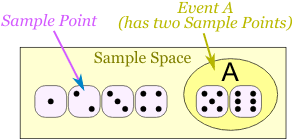
Probability is the measure of the likelihood that an event will occur.[1] Probability is quantified as a number between 0 and 1, where, loosely speaking,[2] 0 indicates impossibility and 1 indicates certainty.[3][4]
The higher the probability of an event, the more likely it is that the
event will occur. A simple example is the tossing of a fair (unbiased)
coin. Since the coin is fair, the two outcomes ("heads" and "tails") are
both equally probable; the probability of "heads" equals the
probability of "tails"; and since no other outcomes are possible, the
probability of either "heads" or "tails" is 1/2 (which could also be
written as 0.5 or 50%).

Etymology:
The word probability derives from the Latin probabilitas, which can also mean "probity", a measure of the authority of a witness in a legal case in Europe, and often correlated with the witness's nobility. In a sense, this differs much from the modern meaning of probability, which, in contrast, is a measure of the weight of empirical evidence, and is arrived at from inductive reasoning and statistical inference.[11]
Applications:

Independent events:
If two events, A and B are independent then the joint probability is

for example, if two coins are flipped the chance of both being heads is  .[30]
.[30]
Mutually exclusive events:
If either event A or event B occurs on a single performance of an experiment this is called the union of the events A and B denoted as  . If two events are mutually exclusive then the probability of either occurring is

For example, the chance of rolling a 1 or 2 on a six-sided die is 
Not mutually exclusive events:
If the events are not mutually exclusive then

For example, when drawing a single card at random from a regular deck
of cards, the chance of getting a heart or a face card (J,Q,K) (or one
that is both) is  ,
because of the 52 cards of a deck 13 are hearts, 12 are face cards, and
3 are both: here the possibilities included in the "3 that are both"
are included in each of the "13 hearts" and the "12 face cards" but
should only be counted once.
,
because of the 52 cards of a deck 13 are hearts, 12 are face cards, and
3 are both: here the possibilities included in the "3 that are both"
are included in each of the "13 hearts" and the "12 face cards" but
should only be counted once.
Conditional probability:
Conditional probability is the probability of some event A, given the occurrence of some other event B. Conditional probability is written  , and is read "the probability of A, given B". It is defined by[31]
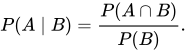
If  then is formally undefined by this expression. However, it is possible to define a conditional probability for some zero-probability events using a σ-algebra of such events (such as those arising from a continuous random variable).[citation needed]
For example, in a bag of 2 red balls and 2 blue balls (4 balls in total), the probability of taking a red ball is  ;
however, when taking a second ball, the probability of it being either a
red ball or a blue ball depends on the ball previously taken, such as,
if a red ball was taken, the probability of picking a red ball again
would be
;
however, when taking a second ball, the probability of it being either a
red ball or a blue ball depends on the ball previously taken, such as,
if a red ball was taken, the probability of picking a red ball again
would be  since only 1 red and 2 blue balls would have been remaining.
Inverse probability:
In probability theory and applications, Bayes' rule relates the odds of event  to event
  , before (prior to) and after (posterior to) conditioning on another event
  . The odds on to event is simply the ratio of the probabilities of the two events. When arbitrarily many events
  are of interest, not just two, the rule can be rephrased as posterior is proportional to prior times likelihood,
  where the proportionality symbol means that the left hand side is
proportional to (i.e., equals a constant times) the right hand side as varies, for fixed or given
(Lee, 2012; Bertsch McGrayne, 2012). In this form it goes back to
Laplace (1774) and to Cournot (1843); see Fienberg (2005). See Inverse probability and Bayes' rule.
where the proportionality symbol means that the left hand side is
proportional to (i.e., equals a constant times) the right hand side as varies, for fixed or given
(Lee, 2012; Bertsch McGrayne, 2012). In this form it goes back to
Laplace (1774) and to Cournot (1843); see Fienberg (2005). See Inverse probability and Bayes' rule.
Examples of Probability:
The term probability
refers to the likelihood of an event occurring. Probability can be
expressed in a variety of ways including a mathematically formal way
such as using percentages. It can also be expressed using vocabulary
such as "unlikely," "likely," "certain," or "possible."
Ways to Express Likelihood of Occurrence:
Some examples of probability include:
- There is a 20 percent chance of rain tomorrow.
- Based on how poorly the interview went, it is unlikely I will get the job.
- Since it is 90 degrees outside, it is impossible it will snow.
- After
flipping this coin 10 times and having it land on heads 8 times, the
probability of landing on heads is still 50 percent. The odds stay the
same regardless of what it landed on before or after the 11th flip of
the coin.
- On a spinner that has four colors occupying equally
sized spaces, there is a one in four probability it will land on any one
color.
- In a drawer of ten socks, 8 of them yellow, there is a twenty percent chance of choosing a sock that is not yellow.
- Since it is sunny and hot, it is very likely I will go to the pool today.
- There is a 50 percent chance of snow tonight.
- Because the ground is warm, it is very unlikely that the snow will stick to the ground.
- There is a foot of snow on the ground; so, it is extremely likely school will not be in session tomorrow.
- She did not pay her mortgage payment three months in a row; so, it is possible her house will be foreclosed upon.
- That employee was rated "Employee of the Month" three times last year; so, it is very likely she will receive a good evaluation.
- Our
team has won all of our football games this season; so, it is likely we
will defeat the worst team in the league when we play against them.
- She comes to work late nearly everyday; so, it is likely she is going to be reprimanded.
- There are one hundred cars on the sales lot that are silver. The probability of a customer choosing a silver car is 50%.
- The probability of winning the lottery is one in many millions.
- There are nine red candies in a bag and one blue candy in the same bag. The chances of picking the blue candy are 10%.
- In my closet are five pairs of shoes, four of which are black. The chances of picking a black pair of shoes is 4 out of 5.
- Since I am not feeling well, it is very unlikely I will be going to a party tonight.
- Given that she calls out of work once a week, it is quite possible that she will do so again this week.
- Since it is supposed to rain tomorrow, it is very likely I will need to use my windshield wipers when I go to work.
- Because his dog barks every time the postal carrier comes to the house, it is very likely the dog will do so today.

No comments:
Post a Comment